Criminal Legal Reform

Increasingly harsh criminal justice policies over the last three decades have resulted in a system that relies on over-criminalization, mass incarceration, and racial injustice.

CLR

Instead of ensuring public safety and addressing the root causes of crime, the war on drugs has led to unconstitutional police practices, unfair and inconsistent sentencing, and abuses of authority which only harm, rather than help, the public, and extremely disproportionately affect minorities.

Nationally, the ACLU's Smart Justice movement has sought to orchestrate national reforms to the “front end” of the criminal justice system from policing to sentencing. This includes putting an end to racially motivated policing and sentencing, increasing government accountability and transparency, and reversing the shift toward excessive incarceration.

The Latest

Resource
Placeholder image

White House Domestic Policy Counsel Office, Leavenworth Cou. Commission re: CoreCivic Leavenworth

Press Release
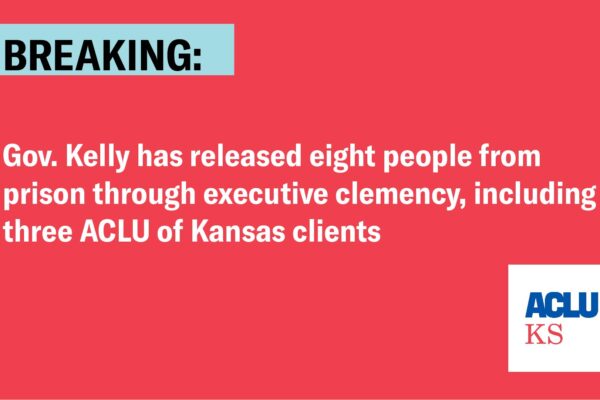
BREAKING: Gov Kelly has released eight people from prison through executive clemency

Gov. Kelly releases three ACLU of Kansas Clemency Project clients, paving the way for many more such releases
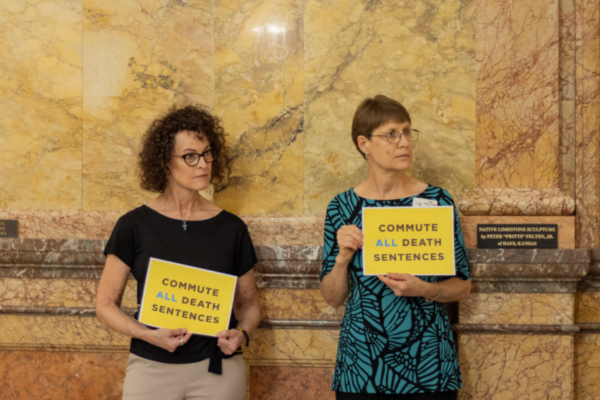
In a historic move the ACLU of Kansas hopes will normalize the use of executive clemency, Governor Laura Kelly today released three affiliate clients from various state prisons via commutation.
News & Commentary
halo act

Kansas ‘Halo Act’ raises constitutional concerns over first responder proximity law

The bill’s passage has drawn opposition from groups like the ACLU and the Kansas Press Association, who says the bill will violate First Amendment rights. Critics say the vague writing of the bill will lead to legal battles over its enforcement.
News & Commentary
topeka capitol

New Kansas law lets police enter ICE agreements without county oversight

“These new provisions break down the boundaries that exist between local and federal operations. They expose agencies in our state to federal civil rights litigation and it’s all for the goal of targeting immigrants in our community,” Logan DeMond, the director of policy and research for ACLU Kansas, said. “This is a direct attack on due process. There are serious constitutional concerns with this legislation. It’s not just an attack on immigrants. It is an attack on all of our rights.”
Legislation
Apr 09, 2026

Gut and Go: Eliminating Own Recognizance Bonds

This bill undermines judicial discretion and disproportionately harms low-income Kansans by mandating arrest and imposing stricter pretrial conditions based solely on charge level rather than individualized risk. These measures will only serve to increase incarceration rates and deepen systemic inequities. This bill significantly limits judicial discretion by prohibiting courts from issuing summonses in felony cases, regardless of individual circumstances. Removing this discretion undermines a core principle of our justice system: decisions should be based on individuals, not just the charges against them. For individuals living paycheck to paycheck, even short periods of pretrial detention can result in job loss, eviction, disruptions to childcare, and financial instability. Wealthier defendants are better positioned to absorb these mandated disruptions or post secured bond; poorer defendants are not.
Status: Vetoed by governor
Position: Oppose
Legislation
Apr 09, 2026

Gut and Go: Expansion of ICE Operations to Local Law Enforcement

This bill expands county sheriffs’ authority and the authority of jails not operated by sheriffs to indefinitely detain individuals for civil immigration purposes, insulates law enforcement from accountability, and removes longstanding democratic oversight. The combined effects of this bill—which is part of a larger legislative attack on immigrants and people of color—raise serious constitutional concerns. It significantly expands the authority of federal law enforcement in Kansas, weakens accountability, and threatens Kansans’ right to engage in lawful dissent.
Status: Vetoed by governor
Position: Oppose
Legislation
Apr 03, 2026

Presumptive Imprisonment and Minimum Bond Amounts

Expanding pre-trial detention practices by reducing how jail credits are applied, imposing more rigid sentencing rules, and setting mandatory minimum bond amounts.
Status: Pending
Position: Oppose
Legislation
Apr 03, 2026

Reducing the Use of Summons in Lieu of Warrants

Limiting the use of a summons instead of a warrant for the arrest of a defendant to misdemeanor crimes and requiring that any bond set on a warrant issued after a failure to appear in response to a summons shall not allow release on the defendant's own recognizance.
Status: Pending
Position: Oppose