
News & Commentary
Aug 21, 2024
After a Kansas district allowed Gideons to hand out Bibles at school, ACLU sends warning
ACLU of Kansas officials say an elementary school principal in Belleville invited a representative from Gideons International to distribute Bibles at the school. In a letter, the ACLU warned that the principal's actions violated the First Amendment, which mandates governmental neutrality when it comes to religion.

Aug 20, 2024
Kansas school principal who helped hand out Bibles to students violated constitution, ACLU says
TOPEKA — A Kansas elementary school principal who invited an evangelical Christian missionary to pass out Bibles to students during their recess in May violated the First Amendment, the American Civil Liberties Union of Kansas warned Monday in a letter to the district.

Apr 09, 2024
Kansas is playing with fire when it comes to mandatory age verification for porn sites
“Senate Bill 394 absolutely does not give license to any state actors to broadly censor LGBTQ+ expression,” Micah Kubic—the executive director of the ACLU of Kansas—told The Pitch in their emailed remarks.

Apr 09, 2024
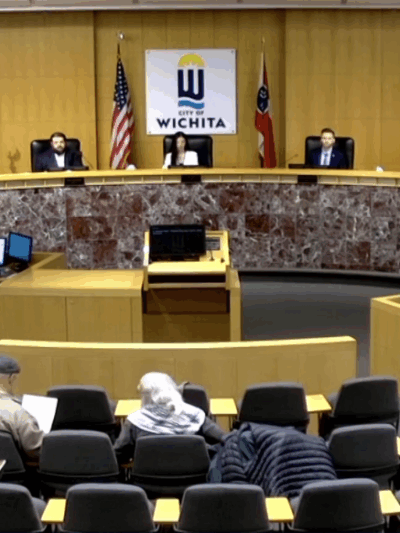
Council approves Wichita Police Department gang list settlement
The Wichita City Council voted 7-0 to approve a $625,000 settlement over the police department’s gang list. The ACLU and Kansas Appleseed claim the list unconstitutionally targets people of color.
Apr 05, 2024
Wichita’s gang list would change under proposed settlement | Wichita Eagle
Wichita’s gang list would change under proposed settlement | Wichita EagleRead today's eEdition Welcome Back! Edit Profile My Subscriptions Sign Out 55°F OBITUARIES SPORTS BUSINESS OPINION DINING JOBS/RECRUITING PERSONAL FINANCE BETTING SHOPPING Home Customer Service Stay Connected eEdition Best of Wichita News Sports Business Entertainment & Food Opinion Obituaries Sports Betting Shopping/Reviews Press Releases Deals & Offers Sponsored Content Classifieds Place an Ad - Celebrations Search Jobs Search Legal Notices Advertising POLITICS & GOVERNMENT Wichita is poised to settle a lawsuit challenging police gang list. Here’s what it means BY MATTHEW KELLY UPDATED APRIL 05, 2024 5:39 PM File photo The city of Wichita is poised to settle a lawsuit brought by Kansas Appleseed and the ACLU of Kansas that contended the Wichita Police Department’s gang list is unconstitutional. Last fall, a federal judge granted class-action status to the 5,245 people on the gang list. If City Council members approve the settlement Tuesday, Wichita will pay $550,000 in legal fees and costs. The mediated agreement would not require Wichita to destroy its gang list as plaintiffs initially called for. Instead, a judge would appoint a special master to oversee its ongoing use by the police department for three years at an additional cost of $75,000 to the city. “This mediated agreement narrows and clarifies the criteria the Wichita Police Department can use to place a person on the gang list/database, with increased oversight on the gang list/database process to review when and how someone can be listed,” the agenda report states. City documents do not elaborate on how the process for placing someone on the gang list would change. The police department would also be required to create a method for members of the public to check if they are included on the gang list/database, and an appeal mechanism for if they think that designation is incorrect. Teresa Woody, a lawyer for Kansas Appleseed, declined to comment on the settlement until after Tuesday’s vote. Sixty percent of people on the gang list are Black and 25% are Hispanic, while only 6% are white. Lawyers for the plaintiffs argue the list disproportionately targets racial minorities. Under current city policy, police have broad discretion to decide who gets placed on the list. The suit argues that people can be identified as a gang member or gang associate based on arbitrary factors such as where they live, what color clothing they wear, where they shop or buy gas and who they are photographed with. Once on the list, members are subjected to intense police scrutiny, frequent stops and searches over minor traffic infractions, minimum $50,000 bail if charged with a violent crime and longer sentences in higher-security prisons if convicted. The police department’s gang list includes 1,728 active gang members, 3,296 inactive gang members and 221 gang associates. “The settlement of this claim does not constitute an admission of liability on the part of the City; rather, it is merely a settlement to resolve disputed claims,” the agenda report states. The suit was filed in 2021 by Kansas Appleseed and the ACLU of Kansas lawyers on behalf of Progeny, a nonprofit juvenile justice organization, and individual plaintiffs Christopher Cooper, Elbert Costello, Martel Costello and Jeremy Levy, Jr. Federal Judge Eric Melgren granted class-action status for gang list members in October. “What this means is that we can go forward as a class, to represent the rights of everybody that’s on the gang list,” Woody said at the time. “That means if we’re successful, the relief we’re asking for — which is basically to change or modify the procedures for getting on the gang list to meet constitutional muster — would apply to everyone on the gang list.” READ NEXT POLITICS & GOVERNMENT Class-action status granted for people on Wichita police gang list in lawsuit against city OCTOBER 12, 2023 5:37 AM READ NEXT POLITICS & GOVERNMENT About 3,000 on Wichita gang list; lawsuit claims it’s unconstitutional discrimination APRIL 15, 2021 5:09 PM This story was originally published April 5, 2024, 1:53 PM. MATTHEW KELLY 316-268-6203 Matthew Kelly joined The Eagle in April 2021. He covers local government and politics in the Wichita area. You can contact him at 316-268-6203 and [email protected]. Take Us With You Real-time updates and all local stories you want right in the palm of your hand. WICHITA EAGLE APP SUBSCRIPTIONS Start a Subscription Customer Service eEdition Vacation Hold Pay Your Bill LEARN MORE About Us Contact Us Newsletters Archives Personal Finance Reviews ADVERTISING McClatchy Advertising Place an Ad Place a Classified Ad Place an Ad - Celebrations Place an Obituary Staffing Solutions Political | Advocacy Advertising Part of the McClatchy Media Network COPYRIGHT COMMENTING POLICY PRIVACY POLICY YOUR PRIVACY CHOICES TERMS OF SERVICE

Mar 15, 2024
Ruling will require Wichita to change disorderly conduct law | Wichita Eagle
“Free speech and expression, especially political protest, are fundamental to our democracy, and police cannot have the power to selectively arrest anyone for speech they disagree with or are angered by. We are glad to see the Court agreed,” Legal Director Sharon Brett said in an email statement.

Dec 15, 2023
Kansas school district that forced Native American boy to cut hair changes dress code policy - Kansas Reflector
Girard School District Board of Education members voted unanimously during a Thursday night meeting to remove a district dress code policy. The change comes after national attention to the story and legal warnings from the American Civil Liberties Union of Kansas.
Nov 22, 2023
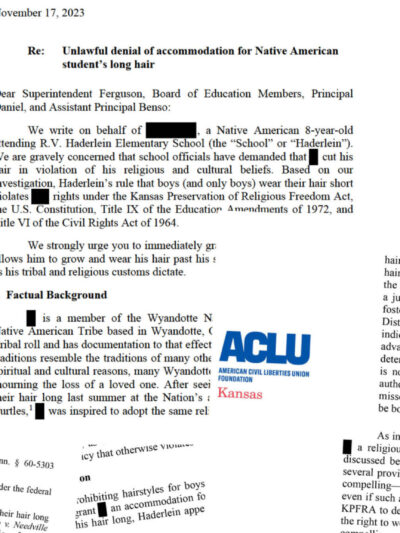
Native American boy forced to cut hair to comply with school hair policy, ACLU says | CNN
An 8-year-old Native American boy in Kansas was forced to cut his hair to comply with his elementary school’s hair policy, according to the Kansas American Civil Liberties Union, which called the policy “discriminatory.”

Nov 20, 2023
Kansas School Demands Native American Student Cut His Hair to Attend - The New York Times`
An 8-year-old Native American boy who had grown out his hair to honor his ancestry was made to get a haircut after being threatened with suspension from school, the American Civil Liberties Union of Kansas said.

Stay Informed
Sign up to be the first to hear about how to take action.
By completing this form, I agree to receive occasional emails per the terms of the ACLU’s privacy statement.
By completing this form, I agree to receive occasional emails per the terms of the ACLU’s privacy statement.