
News & Commentary
Oct 15, 2026
U.S. Rep. Sharice Davids deplores ‘for-sake-of-headlines’ ICE raids in Kansas
Micah Kubic, executive director of ACLU of Kansas, said the U.S. attorney’s office in Kansas was asking residents of southwest Kansas to ignore what they observed occurring in their communities.
“Kansans are seeing through these transparent attempts to turn neighbors against one another,” Kubic said. “Even if the U.S. attorney finds them inconvenient, the facts are clear: masked, unidentified men are recklessly storming our streets, surrounding cars, separating parents from children, then disappearing them into ICE’s creeping network of deplorable jails and prisons.”

Oct 14, 2026
Overland Park police tighten rules for using automatic license plate readers
The ACLU of Kansas said it wants to have more conversations with the department about ALPRs, including reducing the data retention periods even further and limiting data sharing.

Oct 14, 2026
Overland Park police announce new department guidelines for automated license plate readers
“The Overland Park Police Department has engaged in an open, transparent dialogue about its policy on the use of ALPRs. Chief Jokerst and the department have sought the views of a wide range of individuals and organizations, including those like ours, who have divergent perspectives. The OPPD’s willingness to meaningfully engage and take steps to address our concerns is commendable. The ACLU of Kansas will continue to advocate for ending the use of ALPRs entirely, but the updated OPPD policy is a significant step forward in limiting ALPR use, scope and data retention in ways that seek to protect individual rights. We are committed to continuing the respectful, constructive dialogue which Chief Jokerst and OPPD initiated about ALPRs, including by calling for reduced data retention periods and limits on data sharing,” the ACLU said.

Oct 13, 2026
Trans residents in Kansas worry about voting rights during midterms after state revoked IDs
The case, Doe v. State of Kansas, challenges the legality of SB 244, with those most significantly affected by the law at the center. (Disclosure: Ballard Spahr LLP provides legal support to Prism.)
“Hopefully at the end of the day, we can get relief for transgender and intersex people throughout Kansas,” said Harper Seldin, a staff attorney in the ACLU LGBTQ & HIV Project who is working on the case. “There really is no limit to what legislatures are willing to do to try to push transgender people out of public life.”
The state district court is currently hearing arguments for Doe v. Kansas. Seldin hopes that the case progresses swiftly, underlining how trans Kansans can’t live under these legal limitations.
“Our plaintiffs are just ordinary folks who are trying to live their lives in their communities where they’ve been embedded for many years,” Seldin said. “Laws like this basically say, ‘You don’t belong here. You’re not the kind of person who’s fit to be in society with other people. And we’re going to demonstrate that via your driver’s license, making you hang a sign around your neck that makes you declare your trans and intersex status.’”

Oct 13, 2026
Overland Park tightens restrictions on license plate reader data. ACLU calls it a ‘significant step forward’
“The OPPD’s willingness to meaningfully engage and take steps to address our concerns is commendable,” Micah Kubic, executive director of the ACLU of Kansas, said in a statement.
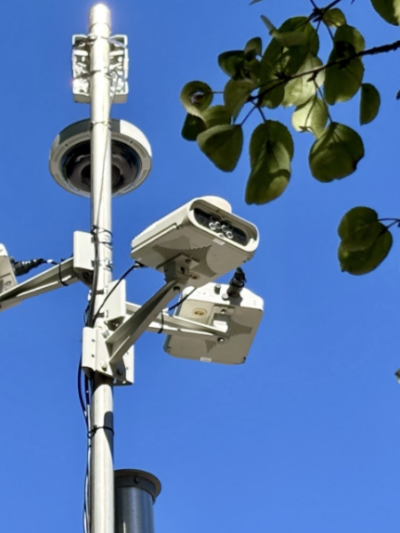
Kubic said Overland Park police Chief Doreen Jokerst, who took over the department two years ago, sought his input. The civil rights nonprofit opposes widespread use of automated license plate readers, or ALPRs, and has launched a campaign against Flock Safety, one of the primary companies in the industry.
“The ACLU of Kansas will continue to advocate for ending the use of ALPRs entirely, but the updated OPPD policy is a significant step forward in limiting ALPR use,” Kubic said.
Oct 09, 2026
Federal officials said Kansas ICE sweep caught ‘heinous criminals,’ then backtracked
“The pattern here is one of asking Kansans to disbelieve the evidence of their own eyes and experience and instead to trust the word of the officials pursuing this particular policy,” Micah Kubic, executive director of the ACLU of Kansas, said in a phone interview. “Rather than acknowledging that people have legitimate concerns here, rather than acknowledging that legal and constitutional rights are being violated constantly, those in the positions of power on this, instead, just tell us all that we don’t know what we’re talking about, that we’re insufficiently grateful to them, and challenge us to simply take their word for it rather than believe our own eyes.”

Oct 08, 2026
Kansas Already Limits Voting to Citizens. So What Would November Constitutional Amendment Change?
The ACLU of Kansas raised a similar concern when lawmakers considered the amendment. In written testimony, policy director Rashane Hamby said changing the Constitution from affirmative voter language to restrictive language could pave the way for future voting restrictions, including another attempt at documentary proof of citizenship.
Oct 07, 2026
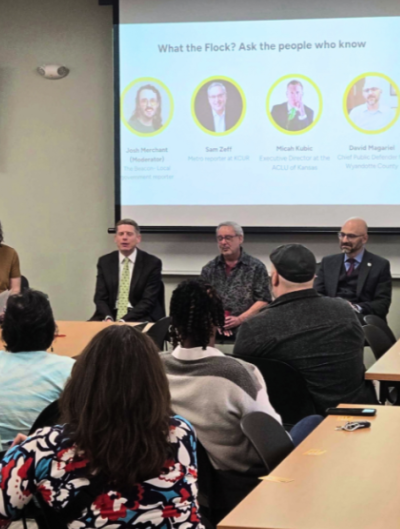
A reader’s question sparked our latest event about Flock cameras
The Beacon’s local government reporter Josh Merchant moderated the discussion. They were joined by Micah Kubic of the ACLU of Kansas, Wyandotte County Chief Public Defender David Magariel and KCUR metro reporter Sam Zeff. Each participant brought a different expertise to the conversation from privacy and civil liberties to how license plate reader information may enter criminal cases and how the technology is being used across state lines.
Oct 02, 2026
Kansas AG Kris Kobach uses transgender people’s social media posts to defend forcibly outing them
In an interview with The Capital-Journal, Harper Seldin, staff attorney for the ACLU, said the posts were not relevant to the ongoing case.
“I think the only relevance here is that the state is trying to use that to create pressure on anonymous Kansans who have been brave enough to show up in person and in court to tell their stories,” he said. “There’s no reason for this.”
Stay Informed
Sign up to be the first to hear about how to take action.
By completing this form, I agree to receive occasional emails per the terms of the ACLU’s privacy statement.
By completing this form, I agree to receive occasional emails per the terms of the ACLU’s privacy statement.